
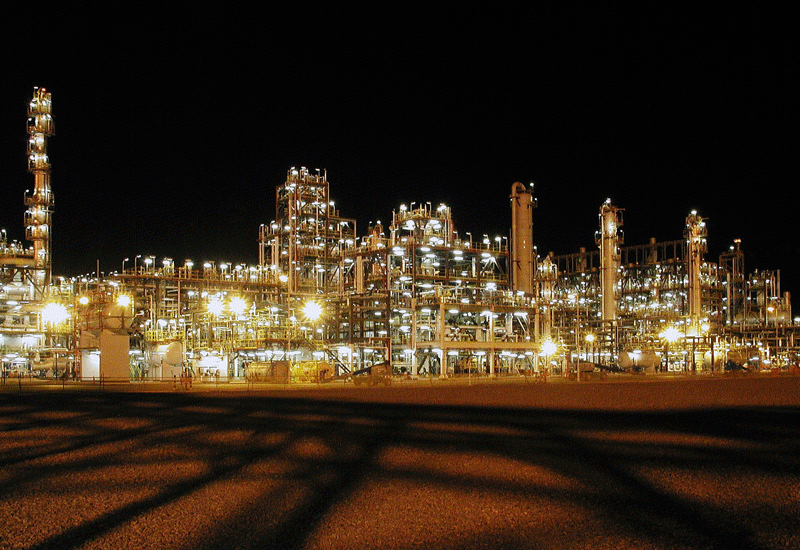
Abu Dhabi National Oil Company (ADNOC) has fully restored operations at its flagship Ruwais Refinery Complex following an operational disruption caused by an Iranian drone attack earlier this year. As the world’s fourth-largest single-site oil refinery, Ruwais boasts a total processing capacity of 922,000 barrels per day (bpd) of crude oil and condensate.
The restart comes at a critical juncture for international energy markets. A combination of Middle Eastern refinery outages and attacks on Russian refining infrastructure had severely restricted global distillate supplies, pushing diesel and jet fuel crack spreads to 15-year highs. The full recovery of Ruwais—coupled with output increases from Kuwait’s Mina Al Zour refinery—brings significant volume back online, helping to stabilize Middle Eastern fuel exports into Europe and Asia.
Ruwais Refinery Overview & Capacity Breakdown
Situated in Al Dhannah, 240 kilometers west of Abu Dhabi city, the Ruwais complex forms the core of ADNOC Refining (a joint venture between ADNOC [65%], Eni [20%], and OMV [15%]). The facility operates through two primary refining centers: Ruwais East and Ruwais West.
ADNOC Refining Operational Portfolio
| Facility / Complex | Nominal Processing Capacity | Primary Feedstock / Focus | Key Secondary Units |
| Ruwais Refinery East | ~505,000 bpd | Murban Crude & Natural Gas Liquids (NGL) | Hydrocracker, Gasoline Plant, Base Oil (Group III) Plant |
| Ruwais Refinery West | ~417,000 bpd | Crude & Heavy Residue Upgrading | 127,000 bpd RFCC, Carbon Black & Delayed Coker Plant |
| Abu Dhabi (Umm Al Nar) Refinery | ~85,000 bpd | Domestic Fuel Supply | Hydrotreating, Catalytic Reforming |
| Total ADNOC Refining Capacity | >1,000,000 bpd | Crude & Condensate | Integrated Downstream & Petrochemical Hub |
Operational Recovery & Market Impact
The March drone strike forced an emergency shutdown of key processing trains at Ruwais, which was further compounded by maritime transit constraints along the Strait of Hormuz. Prior to the disruption, ADNOC exported approximately 600,000 bpd of refined products.
Export Recovery Timeline & Volume Comparison
| Operational Phase | Refined Export Volume | Key Export Destinations | Market Status |
| Pre-Disruption (Baseline) | ~600,000 bpd | Europe, East Africa, Asia-Pacific | Normal Market Supply |
| Post-Attack Impact (Q1–Q2) | ~360,000 bpd (60% capacity) | Regional / Contracted Commitments | Tight Global Distillate Margins |
| Restored Capacity Status | ~420,000+ bpd (70%+ recovery) | Europe & Asia-Pacific | Distillate Margin Stabilization |
With an annual production capacity exceeding 40 million tonnes of refined petroleum products—including ultra-low-sulfur diesel (ULSD), Jet A-1, naphtha, propylene, and anode-grade calcined coke—the plant’s return alleviates global supply bottlenecks for middle distillates.
Upcoming Strategic & Expansion Projects
ADNOC is advancing several major capital projects across its downstream and refining ecosystem as part of its AED 200 Billion ($55 Billion) Project Pipeline (2026–2028).
1. Crude Flexibility Project (CFP)
- Investment: ~$3.5 Billion
- Objective: Modifies Ruwais Refinery West to process up to 420,000 bpd of Upper Zakum crude (a heavier, higher-sulfur offshore grade) instead of light Murban crude.
- Strategic Value: Frees up premium Murban crude for direct export while enabling the refinery to process lower-cost, high-sulfur feedstocks.
2. Ruwais Chemical Derivatives Hub & Borouge 4
- Objective: Expanding the integration between ADNOC Refining and Borouge to convert refined naphtha and off-gases into high-value polyolefins and specialty chemical building blocks.
3. Zero-Carbon & Energy Efficiency Initiatives
- Objective: Upgrading furnace burners, high-pressure steam headers, and flare gas recovery units (FGRU) across Ruwais East and West to lower overall carbon intensity per barrel processed.
Valves & Fluid Control Infrastructure Requirements
Operating crude units, residue fluid catalytic crackers (RFCC), and hydrocrackers under severe pressure, temperature, and corrosive conditions demands specialized flow control hardware:
[Crude / Residue Feedstock]
        │
        ├──► High-Pressure Isolation ──► Gate & DBB Valves (Class 600 - 2500)
        │
        ├──► Catalytic Cracking (RFCC) ──► Alloy 20 / Inconel Severe Service Valves
        │
        ├──► Hydrotreating / Desulfurization ──► NACE MR0175 Compliant SS / Duplex Valves
        │
        └──► Cooling & Utility Systems ──► High-Performance Butterfly & Air Release Valves
- Severe Service Valves: Hydrocracking and delayed coking units require alloy-trimmed metal-seated ball valves and wedge gate valves rated for temperatures exceeding 500°C and pressures up to ASME Class 2500.
- Double Block and Bleed (DBB) Valves: Critical for positive isolation on fuel gas headers, custody transfer lines, and refining manifold blocks to maintain zero-leakage safety standards.
- NACE MR0175 / ISO 15156 Compliance: Required across all high-sulfur crude handling processes (such as Upper Zakum processing under the CFP) to prevent sulfide stress cracking (SSC).
- Summary
- The successful restart of ADNOC’s Ruwais refinery to its full 922,000 bpd processing capacity provides vital stability to global diesel and jet fuel supply chains. As ADNOC executes its AED 200 billion downstream investment strategy through 2028, high-specification valve and piping components will remain critical to maintaining reliable, continuous operations across the Middle East’s energy infrastructure.
- 📍 For high-performance industrial valves engineered for refining and oil & gas applications, visit gccvalves.com.
- 📩 Send project RFQs to:
sales@gccvalves.com