
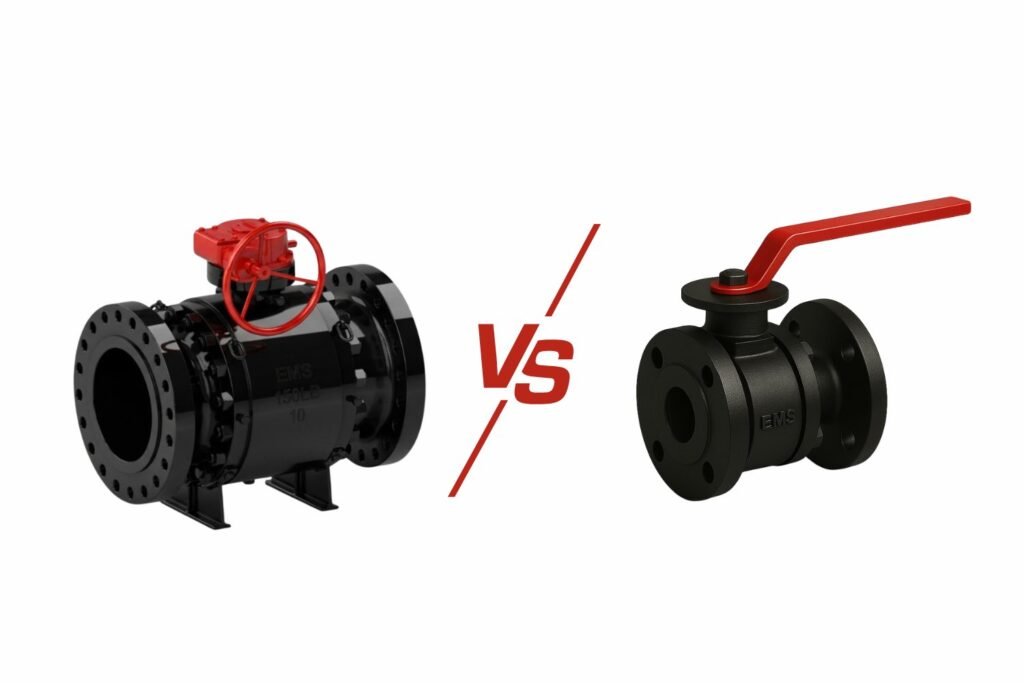
Ball valves are one of the most widely used valve types across oil & gas, water, and process industries — but not all ball valves are built the same way. The two dominant designs, floating and trunnion mounted, look similar on the outside but behave very differently once pressure, size, and service conditions come into play. Choosing the wrong one can mean excessive seat wear, high actuation torque, or a valve that simply isn’t rated for the job.
Here’s how to tell them apart — and how to decide which one belongs in your next project spec.
How a Floating Ball Valve Works
In a floating ball valve, the ball itself is not fixed in place — it’s held only by the two seats on either side, with the stem connected loosely enough that the ball can shift slightly under pressure. When the line pressure pushes against the ball, it “floats” downstream and presses firmly into the downstream seat, creating the seal.
This design is simple, compact, and cost-effective, which is why floating ball valves dominate the small-to-medium size range.
Typical characteristics:
- Common in sizes up to around 10–12 inches
- Generally suited to low-to-medium pressure classes (commonly up to ANSI Class 600, though this varies by manufacturer)
- Lower cost and lighter weight than trunnion designs
- Seat wear increases with valve size and pressure, since the seat bears the full mechanical load of the ball
How a Trunnion Mounted Ball Valve Works
A trunnion mounted ball valve fixes the ball in place using additional bearings — a trunnion at the bottom and the stem at the top — so the ball doesn’t shift under pressure. Instead of the ball pressing into a seat, spring-loaded seats press against the ball, maintaining consistent sealing force regardless of line pressure.
Because the ball itself doesn’t bear the full pressure load, trunnion designs handle much higher pressures and larger sizes without the mechanical strain that would wear out a floating design.
Typical characteristics:
- Used in larger sizes (typically above 8–10 inches) and higher pressure classes (often Class 900 and above, up to Class 2500 for extreme service)
- Lower operating torque than an equivalently sized floating valve, since the ball isn’t dragging against a fixed seat under full pressure
- Higher cost and more complex construction due to additional bearings and spring-loaded seats
- Better suited to frequent cycling and high-pressure-drop applications
Side-by-Side Comparison
| Factor | Floating Ball Valve | Trunnion Mounted Ball Valve |
|---|---|---|
| Typical size range | Small to medium (up to ~12″) | Medium to large (8″+) |
| Pressure rating | Low to medium | Medium to very high |
| Operating torque | Higher, increases with size/pressure | Lower, more consistent |
| Cost | Lower | Higher |
| Mechanical complexity | Simple | More complex (bearings, spring seats) |
| Best suited for | General service, smaller pipelines, utility applications | High-pressure pipelines, refineries, large-diameter transmission lines |
Choosing the Right One for Your Project
A few practical rules of thumb:
- Small-bore, low-pressure utility or plant service — a floating ball valve is usually the more economical and perfectly adequate choice.
- Large-diameter pipelines, high-pressure gas transmission, or refinery process lines — trunnion mounted valves are typically required, both for pressure rating and for keeping actuation torque manageable enough for practical automation.
- Frequent on/off cycling in demanding service — trunnion designs generally hold up better over the long term due to more consistent, lower-stress sealing.
- Budget-sensitive projects within standard pressure classes — floating valves remain the go-to for cost efficiency where the application doesn’t demand trunnion-level performance.
As with any valve selection, the final decision should also account for line size, actuation method, fluid type, and the applicable project standard (API 6D, API 608, or similar) — but understanding this core mechanical difference is the starting point for specifying correctly.
GCCValves supplies both floating and trunnion mounted ball valves compliant with API and regional GCC standards in partnership with SVR GLOBAL Valves, suited to applications ranging from utility service to high-pressure pipeline transmission.