
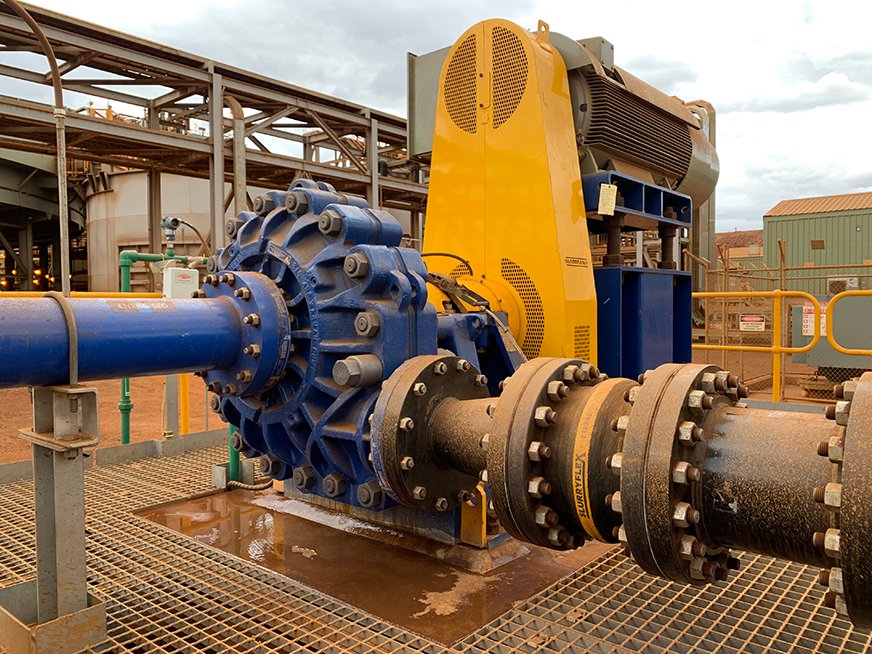
In process engineering, few media present a harsher operating environment than slurry, A complex mixture of suspended solid particles in a liquid carrier. Whether it is abrasive mine tailings, chemical gypsum slurry, sulfur residue, or industrial wastewater sludge, slurries subject piping systems to extreme mechanical abrasion, corrosive chemical attack, high viscosity, and risk of severe line clogging.
Standard off-the-shelf valves (such as basic soft-seated ball or globe valves) deteriorate rapidly when deployed in slurry service. Fine particulates wedge into seat cavities, destroy elastomeric seals, scour metal walls, and freeze mechanical actuators. To maintain plant uptime, prevent catastrophic shutdowns, and achieve lowest Total Cost of Ownership (TCO), industrial operators require purpose-engineered severe-service slurry valves.
Across the Gulf Cooperation Council (GCC)—where mega-scale mining, oil refining, petrochemical processing, aluminum production, and water treatment drive regional economies—the demand for high-performance slurry valves has reached an all-time high.
This comprehensive guide explores the mechanics of slurry flow control, breaks down every major slurry valve design, examines key GCC industrial applications, and explains how GCC VALVES serves as the ultimate B2B sourcing partner with a complete multi-brand product portfolio.
Why Standard Valves Fail in Slurry Applications
Slurries combine the physical hazards of solids handling with the fluid mechanics of liquid transport. When evaluating valve performance in slurry lines, engineers must mitigate three primary failure mechanisms:
- Abrasive Wear & Seat Scouring: High-velocity particles suspended in the liquid stream act like liquid sandpaper, continuously eroding internal metal bodies, valve seats, and sealing discs.
- Dead Cavity Entrapment: Conventional valves feature internal body cavities where slurry solids settle out of suspension. As these solids pack and harden, the valve becomes impossible to cycle, resulting in sheared stems or stalled actuators.
- Corrosive Degradation: Many industrial slurries (such as acidic leach liquors or sulfur slurries) are both abrasive and highly corrosive. This dual mechanism—corrosion-erosion—accelerates material loss at exponential rates compared to clean fluid applications.
To overcome these challenges, specialized valve geometries, resilient full-bore sleeves, and advanced hard-facing materials (such as Tungsten Carbide, Stellite, and ceramic linings) are mandatory.
Comprehensive Overview of Slurry Valve Types
Choosing the correct valve for slurry handling depends on solid concentration, particle size, process pressure, temperature, and chemical composition. Below is an in-depth look at the primary valve types deployed in severe slurry service:
| Valve Type | Primary Mechanism | Best Suited For | Key Advantages |
| Slurry Knife Gate Valve (KGV) | Sharpened blade/gate shearing through heavy media into dual elastomer sleeves | High-density slurries, mineral tailings, ash handling | Shearing capability, low pressure drop, renewable sleeves |
| Pinch Valve (Mechanical / Pneumatic) | Heavy-duty elastomer sleeve compressed along centerline | Thick paste backfill, highly abrasive slurries, lime slurry | 100% full port, zero internal metal contact, no dead cavities |
| Metal-Seated Ball Valve (SSBV) | Precision-ground metal ball with hard-faced coatings (HVOF) | High-temperature, high-pressure, abrasive slurries | Bi-directional drop-tight shutoff, extreme pressure capability |
| Slurry Check Valve | Flexible elastomer ball or swing disc preventing backflow | Pump discharge loops, multi-pump changeover | Self-cleaning design, quick response against back-pressure |
| Lined Butterfly & Diaphragm Valves | Rubber/PTFE lined body with isolated disc/diaphragm | Low-to-medium concentration chemical slurries | Light weight, cost-effective, high corrosion resistance |
1. Slurry Knife Gate Valves (KGV)
Slurry knife gate valves represent the workhorse of tailings pipelines and mineral processing. Unlike standard wafer knife gates, slurry-spec KGVs feature heavy-duty dual elastomer perimeter sleeves.
- How It Works: When open, the two elastomeric sleeves push against each other under compression, forming a continuous, full-bore passage that completely isolates the metal body from the slurry flow. As the valve closes, the heavy-duty metal blade pushes between the sleeves, slicing through trapped solids and discharging a small amount of slurry outward through a bottom flush port to prevent packing.
- Key Strengths: High flow capacity, excellent shearing force through settled bed layers, easy in-line sleeve replacement, and zero seat cavity obstruction.
2. Air Release Valves (Pneumatic & Mechanical)
Pinch valves offer the simplest yet most effective fluid isolation design for aggressive slurries.
- How It Works: The only component in contact with the process fluid is a heavy-duty, reinforced elastomer sleeve (available in Natural Rubber, EPDM, Neoprene, or Nitrile). In pneumatic models, direct air pressure applied to the outer sleeve body collapses the sleeve shut. In mechanical models, dual pinching bars compress the sleeve along the centerline.
- Key Strengths: Zero dead cavities for solids to collect, straight-through full-port flow, outstanding resistance to severe particle abrasion, and quiet, non-clogging operation.
3. Severe-Service Metal-Seated Ball Valves (SSBV)
When slurry applications combine abrasive particulates with high pressure or elevated temperatures (exceeding limits of elastomeric sleeves), metal-seated ball valves become the industry standard.
- How It Works: Features a precision-matched ball and seat set treated with High-Velocity Oxygen Fuel (HVOF) coatings, such as Chromium Carbide or Tungsten Carbide. Spring-loaded seat design maintains continuous contact between the ball and seat, actively scraping slurry film off the ball surface during operation.
- Key Strengths: Absolute drop-tight isolation under extreme pressures (Class 300 to Class 2500), high thermal resistance, and bi-directional sealing.
4. Slurry Check Valves & Ball Check Valves
To protect slurry pumps from damaging backflow and water-hammer shock, non-return valves engineered for solids handling are essential.
- How It Works: Slurry ball check valves utilize a dense, rubber-coated ball that travels in an offset chamber. Under forward flow, the ball lifts entirely out of the flow path. When flow reverses, gravity and back-pressure guide the ball down onto its elastomeric seat.
- Key Strengths: Self-cleaning motion prevents solid buildup; unimpeded flow channel minimizes head loss and slurry turbulence.
Slurry Valve Applications & Industrial Relevance in the GCC Region
The Gulf Cooperation Council (GCC) is undergoing massive industrial expansion under regional development frameworks such as Saudi Vision 2030, UAE Operation 300bn, and Oman Vision 2040. Slurry management is vital across several anchor industries in the region
1. Mining & Mineral Processing (Saudi Arabia & Oman)
- Regional Context: Saudi Arabia’s mining sector—led by entities like Ma’aden—is rapidly growing as the “third pillar” of Saudi industry. Massive operations in phosphate fertilizer production (Wa’ad Al Shamal), bauxite processing, and gold mining generate millions of tons of slurry daily.
- Valve Requirement: Bi-directional heavy-duty knife gate valves, pinch valves for paste backfill, and rubber-lined slurry check valves installed on slurry pump discharge lines, hydrocyclone feeds, and thickener underflow systems.
2. Aluminum Smelting & Alumina Refining (UAE & Bahrain)
- Regional Context: The GCC hosts world-leading aluminum producers, including Emirates Global Aluminium (EGA) in the UAE and Aluminium Bahrain (Alba). The Bayer process used in alumina extraction involves highly alkaline, high-temperature bauxite slurry (red mud).
- Valve Requirement: Severe-service metal-seated ball valves and alkali-resistant slurry knife gate valves capable of enduring thermal cycling, high pH erosion, and heavy scaling.
3. Hydrocarbon Processing & Sulfur Recovery (Qatar, UAE, Kuwait)
- Regional Context: Natural gas purification (such as Qatar’s North Field expansion and UAE’s sour gas projects) and downstream refinery cracking units (FCC/coker units) routinely process heavy sulfur slurry, catalyst fines, and petroleum coke slurries.
- Valve Requirement: High-alloy (Inconel, Monel, Stainless Steel 316/317, Titanium) metal-seated ball valves and severe-service gate valves engineered for thermal shock, fugitive emissions compliance, and slurry particle resistance.
4. Municipal Wastewater & Industrial Effluent Treatment (Across GCC)
- Regional Context: Rapid urbanization across Dubai, Riyadh, Abu Dhabi, Doha, and Muscat requires large-scale wastewater reclamation and sludge treatment plants. Sludge and grit slurries require clog-free, low-maintenance flow isolation.
- Valve Requirement: Elastomer-sleeve pinch valves, eccentric plug valves, and resilient-seated slurry knife gate valves for sludge digesters, grit chambers, and lime dosing lines.
5. Water Desalination & Brine Management
- Regional Context: The GCC relies heavily on seawater desalination. Pre-treatment filtration backwash, lime softening sludge, and concentrated brine streams carry crystalline solids that quickly erode standard valve internals.
- Valve Requirement: Duplex / Super Duplex Stainless Steel slurry valves, PTFE-lined butterfly valves, and rubber-lined slurry check valves to combat chloride corrosion paired with solids abrasion.
Why GCC VALVES is Your Ultimate Procurement Partner
Navigating severe service slurry applications requires precise engineering specs, verified metallurgy, fast lead times, and reliable manufacturer compliance. GCC VALVES stands as the premier digital B2B e-commerce platform and industrial valve trading division catering specifically to the Middle East market. For Pipes & Fittings check here.
“GCC VALVES bridges global severe-service manufacturing expertise with local Middle Eastern procurement agility.”