
Difference Between T-Type vs. Y-Type Strainers, As a premier supplier of industrial flow control solutions across the Middle East, GCC Valves specializes in delivering high-performance, project-specific valves and piping components designed to withstand the region’s harsh operating conditions. From major desalination plants to high-pressure oil and gas lines, we ensure process integrity at every stage.
Protecting downstream equipment—such as pumps, control valves, and delicate instrumentation—starts with selecting the right mechanical filtration. Pipeline strainers serve as this critical first line of defense. However, choosing between a T-Type (Straight-Type) Strainer and a Y-Type Strainer is a common crossroads for procurement managers and piping engineers alike.
While both components fulfill the same fundamental objective of trapping debris, their structural geometry, flow dynamics, and maintenance requirements are vastly different. Here is how they compare.
1. What is a Y-Type Strainer?
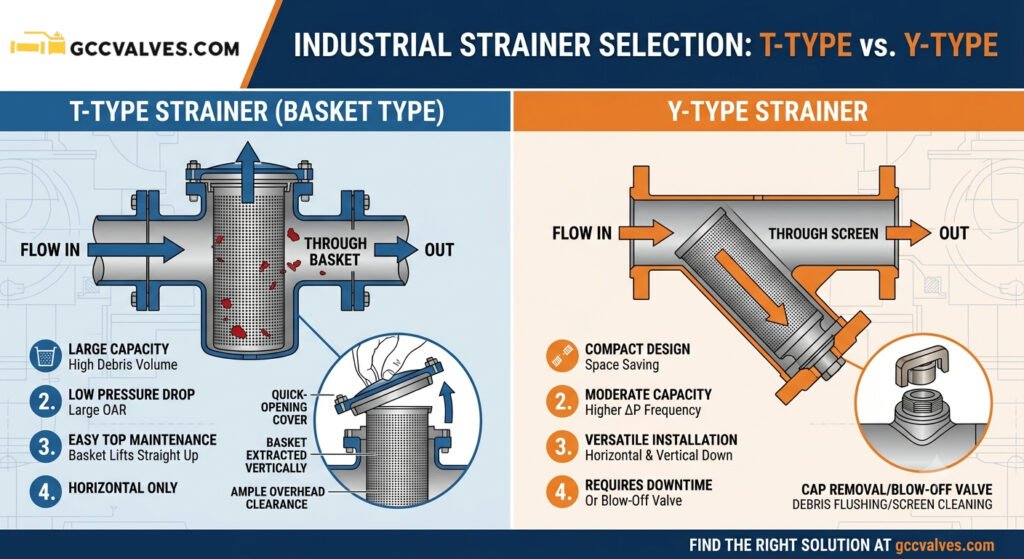
The Y-Type strainer features a compact design where the filter element leg branches off the main line at an angled projection, creating a distinct “Y” shape.
- How it Works: Fluid enters the inlet, passes through the perforated screen or mesh basket inside the angled chamber, and continues out the discharge side. Debris is captured within the lower leg.
- Orientation Versatility: One of its greatest advantages is flexibility. It can be installed in both horizontal and vertical (downward flow) pipelines.
- Ideal Media: Excellent for high-pressure systems and media with low debris concentration, such as steam, air, and gases.
2. What is a T-Type Strainer?
A T-Type strainer (often referred to as a straight-type or basket strainer) features a vertical housing chamber positioned perpendicular to the flow path, forming a “T” profile.
- How it Works: The fluid enters the main body, drops straight into a vertically suspended large-capacity basket, and exits through the outlet.
- Orientation Limits: T-strainers are strictly limited to horizontal pipeline configurations.
- Ideal Media: Designed primarily for liquid systems carrying higher concentrations of solids, where minimizing pressure drops is a operational priority.
Head-to-Head Comparison
To ensure your system remains efficient, consider these crucial performance trade-offs:
A. Debris Capacity & Pressure Drop
- Y-Type: Because the angled chamber is relatively narrow, it has a smaller screen surface area. It fills up faster, which can lead to a more rapid increase in pressure drop ($\Delta P$) if regular cleaning is neglected.
- T-Type: The vertical basket design offers a significantly larger open area ratio (OAR). This massive internal volume yields a consistently lower initial pressure drop and allows the strainer to run for much longer intervals before clogging.
B. Maintenance and Servicing
- Y-Type: Cleaning usually requires shutting down the line and removing the flanged cap to extract the screen. While they can be fitted with a blow-down valve for automatic flushing of light debris, heavy clearing requires physical labor and can result in fluid spillage.
- T-Type: Engineered explicitly for easy maintenance. The top cover can be configured with quick-opening mechanisms (like swing-bolts or quick-release clamps). Because the basket sits vertically, maintenance crews can easily lift it straight out from the top without draining the entire fluid line.
C. Spatial Footprint
- Y-Type: Compact and lightweight, making it perfect for tight structural skids and dense piping networks.
- T-Type: Larger, heavier, and requires ample overhead clearance so the basket can be fully extracted upward during servicing.
Quick Selection Matrix
| Operational Feature | Y-Type Strainer | T-Type Strainer (Basket) |
| Pipeline Alignment | Horizontal or Vertical (Downward) | Horizontal Only |
| Holding Capacity | Low to Medium | High |
| Pressure Drop Profile | Tends to rise quickly under load | Stays consistently low |
| Footprint / Weight | Compact & Lightweight | Large & Heavy |
| Primary Applications | Steam, Gas, Clean Liquids | Liquids, Water Treatment, Oils |
| Servicing Style | Bottom/Side extraction | Top vertical lift-out |
Engineering Selection Guide: Which Should You Specify?
Specify a Y-Type Strainer if:
- You are routing a pipeline vertically or face rigid spatial constraints.
- The system handles steam, air, or gas lines where particulates are minimal.
- Operating pressures are exceptionally high (the compact geometry naturally handles high stress).
Specify a T-Type Strainer if:
- The application involves heavy liquid processing (raw water, chemical fluids, or heavy oil) with higher particulate loading.
- The system cannot tolerate frequent operational shutdowns for cleaning.
- You are safeguarding expensive, flow-sensitive downstream assets like multi-stage pumps or digital flow meters that require stable, low-resistance flow.
Partner with GCC Valves
Getting the right strainer profile, material grade (such as ASTM A216 WCC, Stainless Steel, or Duplex alloys), and mesh rating is vital to avoiding premature pipeline wear.
Need a technical consultation? Contact the engineering desk at GCC Valves to review your project submittal requirements and optimize your piping systems for maximum uptime. Need pipes or fittings? Checkout out Piping Division.